
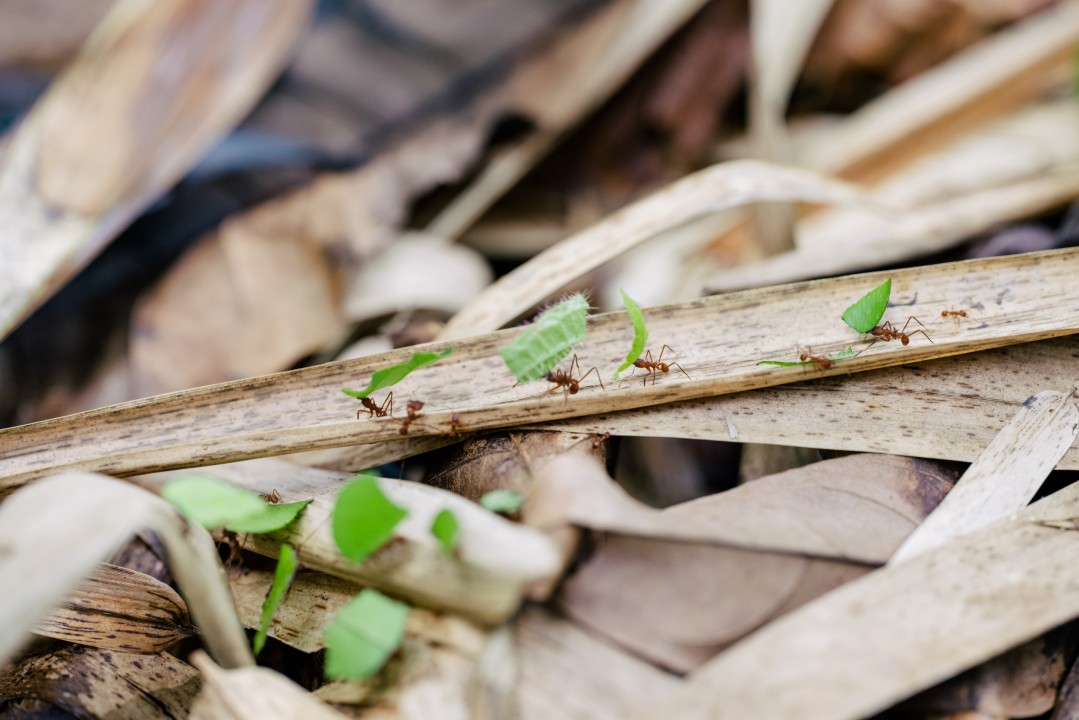
Imagine millions of leafcutter ants on parade through a tropical forest, driven by a craving mysterious to humans, then they suddenly stream up a towering tree trunk. How do they know exactly which species of leaves to cut for their underground fungus garden? The ants don’t eat the leaves, they eat the fungus.
Researchers think that the choices ants make about what to bring back to the nest may be driven by the nutritional needs of their fungus crop.
Even the most primitive species of attine ants navigate a complex forest environment. They walk past many resources to pick up a tiny piece of insect poop that is exactly what they were looking for. They take it back to the nest and use it to grow a fungus.
Ants are brilliant at detecting nutrients based on taste receptors in their mouthparts. Leafcutters are very good at regulating protein intake because protein is often toxic to the fungi. If the ants bring too much protein into the garden, the fungus dies.
Human farmers learned exactly what the fundamental nutritional niche of corn is and can target this using specific fertilizers. The ants appear to know the same thing, surviving by satisfying the nutritional needs of their fungus crops.
Leafcutter ants can harvest a bit more protein than their primitive ancestors. Their fungal cultivar is more robust to fluctuating protein levels. That may allow them to scale up their farms.
In parallel to human cultural evolution where farmers and their crops have become increasingly co-dependent, so too have the ants and their fungal cultivar, highlighting the fact that naturally selected farming systems have potential to shed light on principles of nutritional sustainability for culturally evolved human farming.
From big mammals like the jaguar, to little insects like the leafcutter ant, at the Mamoní Valley Preserve we encourage the preservation and the study of all living creatures that inhabit our Valley.

Leave a Reply