
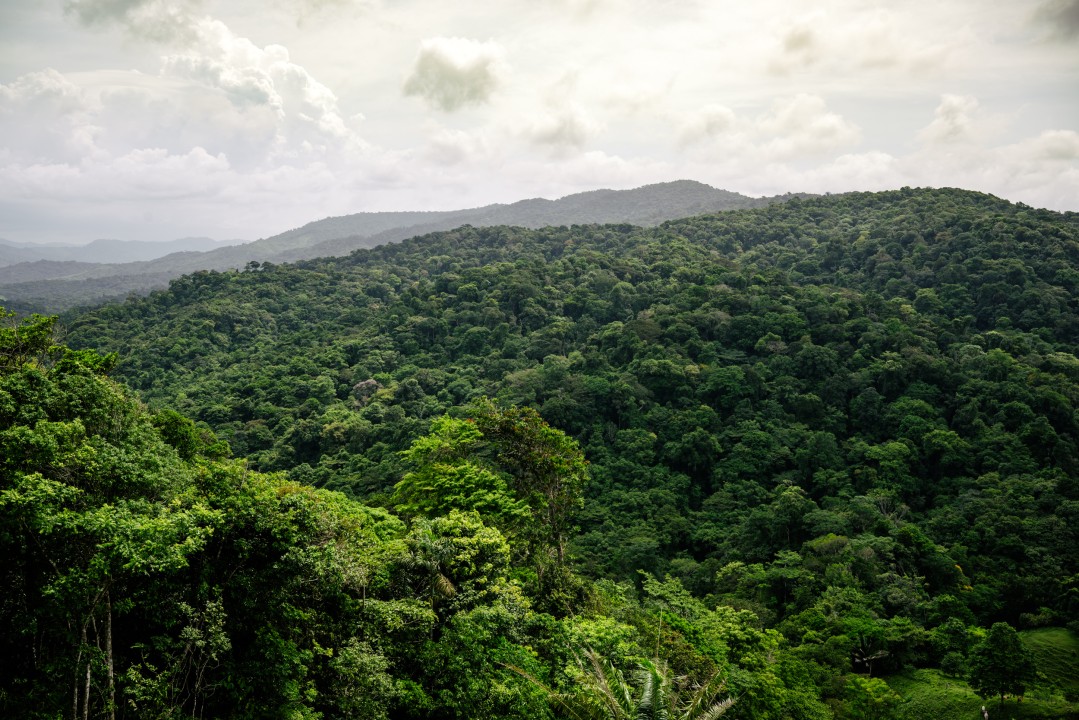
When the Mamoní Valley Preserve initiative started in 2005, 40% of the primary forest had been lost in the Valley to cattle raising and agricultural purposes. Since then and until today, 20% of the forest cover has been recovered in the preserve.
Forests in Darien, Panama, are crucial for carbon storage, biodiversity conservation and the livelihoods of indigenous groups. Through a participatory forest-carbon monitoring project, scientists uncovered sources of above-ground biomass (AGB) variation in Darien.
They analyzed plots distributed across a large, mature forest landscape, in undisturbed and disturbed areas, and found that Darien has the highest carbon stocks among nine mature forest sites across the Neotropics, and the second-highest tree species richness among five mature forest sites in the region.
They also discovered that, although half of the plots in the sample had experienced traditional indigenous extractive activities, satellite analyses of vegetation cover did not detect changes in canopy height or noticeable damage to the landscape, like agriculture or cattle ranching would. However, disturbed plots harbored 54% less biomass than intact forests, so their AGB volumes differed vastly from those of undisturbed plots.
This led researchers to learn that the main determinant of AGB variation is the level of disturbance in the forest. So, the amount of organic matter above the ground and the amount of carbon it stores is mainly affected by the selective extraction of large trees rather than by other factors.
The project demonstrated how important these forests are for climate-change mitigation, biodiversity conservation and the well-being of indigenous peoples.
Forest conservation alone will never be enough. But to continue to preserve natural areas and identify high-sequestration areas, the MVP has had an important role in preventing almost 25.000 tons of C02 emissions annually, which translates to 12,500 gasoline cars for one year, through avoided deforestation.

Leave a Reply